|
 Metallic photos of the sun by renowned photographer Greg Piepol bring together the best of art and science. Buy one or a whole set. They make a stellar gift. Metallic photos of the sun by renowned photographer Greg Piepol bring together the best of art and science. Buy one or a whole set. They make a stellar gift. |
| |
SPINNING ASTEROID FLYBY: Newly-discovered asteroid 2011 GP59 is
lying past Earth today, April 15th, not far beyond the orbit of the Moon
(1.4 LD). There's no danger of a collision, but the 50-meter space rock
is remarkable: It is elongated and spinning once every 7.5 minutes.
This causes the asteroid to flash like a strobe light. A video taken by
Joe Pollock of Appalachian State University on April 11th shows the
effect nicely. Experienced amateur astronomers using mid-sized
telescopes can watch 2011 GP59 strobe through the constellations
Virgo and Hydra tonight with a peak brightness near 13th magnitude.
[3D orbit] [ephemeris] [JPL press release] [more images: #1, #2, #3]
SUNSPOT SUNSET: The face of the sun is dotted with active regions.
Andrew Chan of Manila, the Philippines, 'spotted' three of them at
sunset on April 15th:
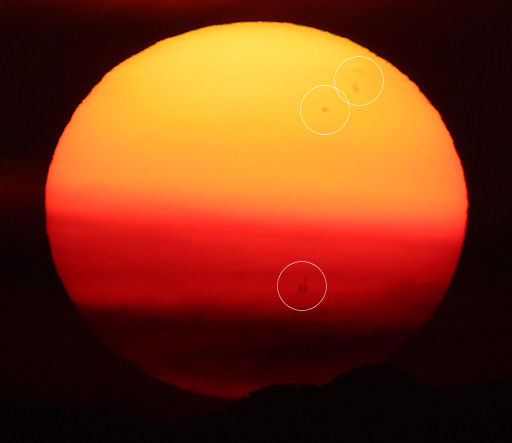
"The sky condition was spectacular on my way home from work,
and a perfect sunset was imminent," says Chan. "I drove fast,
arriving home barely 5 minutes before the sun sank into the horizon.
I quickly grabbed my camera, attached it to my 600mm refractor,
and dashed toward our roofdeck observatory. Never mind the
tripod/mount; never mind the filters! I simply used our roof's ledges
as my tripod and fired away! The sun quickly waved goodbye for
the day...but not before I captured this image."
STRING OF PEARLS: No, it's not a fleet of alien spacecraft. Nor is
it a disintegrating comet, although the resemblence to
Shoemaker-Levy 9 is striking. What could it be? Play the video,
make your best guess, then scroll down for the answer.
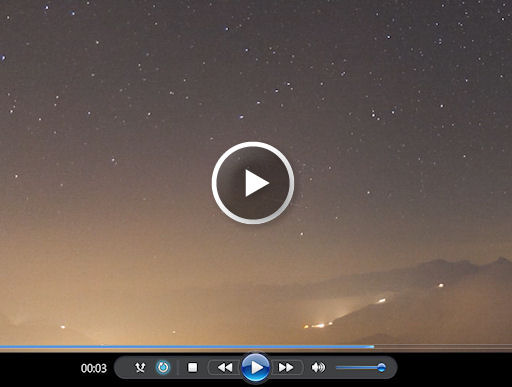
What you just saw was sunlight glinting off a line of ten
geosynchronous satellites stretched over Rigikulm, Switzerland,
on March 5th. One by one, the illuminated satellites flare and
then subside as they enter the shadow of our planet.
"The 'string of pearls' phenomenon is best seen during
early-spring nights when the declination of the sun is
equal to that of the geosychronous orbit, e.g. -7o as measured
from Switzerland," says photographer Roland Stalder. "This short
video sequence (130 images at 25 fps) is part of an all-night
timelapse with 1630 images, where over 50 geosynchronous
satellite flares can be found. A FullHD BlueRay disk can be ordered
though me."
April 2011 Aurora Gallery
[previous Aprils: 2010, 2009, 2008, 2007, 2006, 2005, 2004, 2003, 2002]
Potentially Hazardous Asteroids (PHAs) are space rocks larger
than approximately 100m that can come closer to Earth than
0.05 AU. None of the known PHAs is on a collision course with
our planet, although astronomers are finding new ones all the time.
On April 16, 2011 there were 1218 potentially hazardous asteroids.
Recent & Upcoming Earth-asteroid encounters:
| Asteroid | Date(UT) | Miss Distance | Mag. | Size |
| 2011 GE | Apr 13 | 4.8 LD | -- | 28 m |
| 2011 GZ2 | Apr 8 | 2.7 LD | -- | 26 m |
| 2011 FT53 | Apr 9 | 6 LD | -- | 34 m |
| 2011 GE | Apr 13 | 4.8 LD | -- | 28 m |
| 2011 GP59 | Apr 15 | 1.4 LD | -- | 58 m |
| 2002 DB4 | Apr 15 | 62.5 LD | -- | 2.2 km |
| 2011 GJ3 | Apr 27 | 7.7 LD | -- | 24 m |
| 2008 UC202 | Apr 27 | 8.9 LD | -- | 10 m |
| 2011 GP59 | Apr 15 | 1.4 LD | -- | 58 m |
| 2009 UK20 | May 2 | 8.6 LD | -- | 23 m |
| 2002 DB4 | Apr 15 | 62.5 LD | -- | 2.2 km |
| 2008 FU6 | May 5 | 75.5 LD | -- | 1.2 km |
| 2003 YT1 | May 5 | 65.3 LD | -- | 2.5 km |
| 2002 JC | Jun 1 | 57.5 LD | -- | 1.6 km |
| 2009 BD | Jun 2 | 0.9 LD | -- | 9 m |
| 2002 JB9 | Jun 11 | 71.5 LD | -- | 3.2 km |
| 2001 VH75 | Jun 12 | 42.2 LD | -- | 1.1 km |
| 2011 GJ3 | Apr 27 | 7.7 LD | -- | 24 m |
| 2008 UC202 | Apr 27 | 8.9 LD | -- | 10 m |
| 2004 LO2 | Jun 15 | 9.9 LD | -- | 48 m |
| 2009 UK20 | May 2 | 8.6 LD | -- | 23 m |
| 2008 FU6 | May 5 | 75.5 LD | -- | 1.2 km |
| 2003 YT1 | May 5 | 65.3 LD | -- | 2.5 km |
| 2001 QP181 | Jul 2 | 35.1 LD | -- | 1.0 km |
| 2011 GA55 | Jul 6 | 63.9 LD | -- | 1.0 km |
| 2002 JC | Jun 1 | 57.5 LD | -- | 1.6 km |
| 2011 EZ78 | Jul 10 | 37.4 LD | -- | 1.6 km |
| 2009 BD | Jun 2 | 0.9 LD | -- | 9 m |
| 2003 YS117 | Jul 14 | 73.9 LD | -- | 1.0 km |
| 2002 JB9 | Jun 11 | 71.5 LD | -- | 3.2 km |
| 2001 VH75 | Jun 12 | 42.2 LD | -- | 1.1 km |
| 2004 LO2 | Jun 15 | 9.9 LD | -- | 48 m |
| 2001 QP181 | Jul 2 | 35.1 LD | -- | 1.0 km |
| 2011 GA55 | Jul 6 | 63.9 LD | -- | 1.0 km |
| 2011 EZ78 | Jul 10 | 37.4 LD | -- | 1.6 km |
| 2003 YS117 | Jul 14 | 73.9 LD | -- | 1.0 km |
 |
Notes: LD means "Lunar Distance." 1 LD = 384,401 km, the
distance between Earth and the Moon. 1 LD also equals 0.00256
AU. MAG is the visual magnitude of the asteroid on the date of
closest approach.
| The official U.S. government space weather bureau |
| The first place to look for information about sundogs, pillars,
rainbows and related phenomena. |
| Researchers call it a "Hubble for the sun." SDO is the most advanced
solar observatory ever. |
| 3D views of the sun from NASA's Solar and Terrestrial Relations
Observatory |
| Realtime and archival images of the Sun from SOHO. |
| from the NOAA Space Environment Center |
| the underlying science of space weather |
| for out-of-this-world printing and graphics |
|
|





No hay comentarios:
Publicar un comentario