
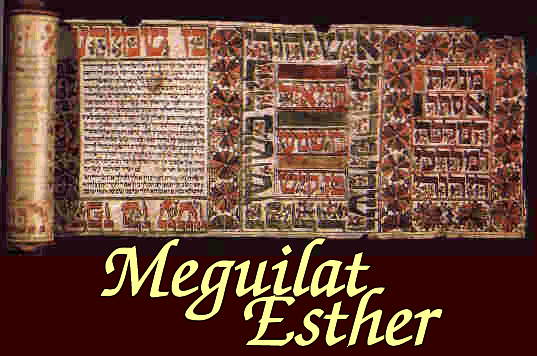
La Meguilat Esther
Parte I
1. Aconteció en los días del rey Ajashverosh, quien reinó sobre 127 naciones desde Jodu hasta Cush.
2. En aquellos días, el rey Ajashverosh se sentó en su trono real en la Capital de Shushán.
3. En el tercer año de su reinado hizo un banquete para todos sus oficiales y sus siervos, el ejército de Parás y Maday, los nobles y los oficiales de todos los países estuvieron presentes.
4. Por mucho tiempo, por 180 días hizo gala de las riquezas de su reino y la belleza y magnificencia de su reinado.
5. Y cuando estos días terminaron, el rey hizo una fiesta durante siete días para todo el pueblo de la Capital de Shushan, tanto para las personas distinguidas, como para las personas simples, en el jardín del Palacio Real.
6. Había cortinas de fino algodón blanco y lana azul celeste, sostenidas por cordones de lino fino y lana morada, colgados de varillas de plata y pilares de mármol. Habían sofás de oro y plata y el piso estaba hecho de precioso mármol de color verde y blanco.
7. Las bebidas se sirvieron en copas de oro, cada copa diferente de la otra y había una gran cantidad de vino real, como sólo un rey podría permitirse.
8. Y las bebidas fueron servidas de acuerdo a ésta orden: "Nadie debe ser forzado". Ellos hicieron esto porque el rey había fijado y ordenado a todos sus oficiales de hacer según el gusto de cada huésped.
9. La reina Vashti también hizo un banquete para las mujeres en el palacio del rey Ajashverosh.
10. En el séptimo día, cuando el rey estaba un poco ebrio, él le habló a Mehuman, Biztá, Jarvona, Bigtá, Abagta, Zetar y Jarcás, quienes eran los siete sirvientes principales del rey Ajashverosh.
11. Él les ordenó a ellos traer a la reina Vashti delante de él, llevando su corona real, para mostrar su belleza a la gente y a los oficiales, ya que ella era muy hermosa.
12. Pero la reina Vashti se rehusó a obedecer la orden que el rey había mandado con sus sirvientes. El rey se puso muy furioso, estaba enardecido por la furia.
13. Entonces el rey consultó con sus sabios astrólogos pues el rey acostumbraba a discutir sus problemas con gente que conocía las reglas y las leyes.
14. Los sabios más cercanos al rey eran Carshena, Shetar, Admata, Tarshish, Merés, Marsena y Memujan, quienes eran los siete oficiales de Parás y Maday a los que siempre se les permitía ver al rey, y los cuales eran los más altos oficiales en el reino.
15. El rey Ajashverosh quería que ellos le dijeran la manera correcta de castigar a la reina Vashti por no obedecer la orden que él había enviado a los sirvientes.
16. Memujan habló ante el rey y los oficiales: "No sólo contra el rey pecó la reina Vashti, sino contra todos los oficiales y toda la gente en todos los países del rey Ajashverosh".
17. "Porque todas las mujeres se darán cuenta de lo que la reina ha hecho y ellas insultarán a sus propios esposos. Ellas dirán, "Aún el rey Ajashverosh ordenó a la reina Vashti presentarse ante él y ella se negó".
18. "En cuanto las princesas de Parás y Maday escuchen lo que ha hecho la reina Vashti ellas hablarán de la misma manera a todos los oficiales del rey y va a haber mucha humillación y furia".
19. "Si el rey le agrada la idea, que se expida un decreto real y que se escriba entre las leyes de Parás y Maday, para que no pueda ser cambiado: "Que la reina Vashti nunca más venga ante la presencia del rey Ajashverosh y que en su lugar el rey escoja para reina a una que sea mejor que ella".
20. "Y así cuando el nuevo decreto del rey sea publicado en todo su reino aunque el reino sea muy extenso, entonces todas las esposas mostrarán respeto por sus esposos, distinguidos y simples por igual".
21. Al rey y sus oficiales les agradó la idea y el rey hizo como le sugirió Memuján.
22. Él mandó cartas a todos los países del rey, a cada país en su propia escritura, a cada nación en su propia lengua, ordenándoles que cada hombre sea el amo en su propio hogar y que toda la familia hable la lengua de su pueblo y no la de su esposa.
Parte II
1. Después que todo esto aconteció, cuando la furia del rey Ajashverosh se apaciguó, él se acordó de Vashti y lo que ella le había hecho y como ella había sido castigada.
2. Entonces los jóvenes sirvientes del rey dijeron: "Busquémosle al rey, vírgenes jóvenes y hermosas".
3. "Y que nombre el rey agentes en todos los países de su reino, que hagan reunir a todas las jóvenes bellas y las traigan a la capital de Shushan al harem, bajo el cuidado de Jegai, el sirviente del rey que vigila a las mujeres y proveerlas así con cosméticos".
4. "Entonces la joven que sea de mayor agrado del rey se convertirá en reina en el lugar de Vashti". Al rey le agradó la idea y así se hizo.
5. Había cierto judío en la capital de Shushan de nombre Mordejai, hijo de Yaír, hijo de Shimi, hijo de Kish de la tribu de Binyamín.
6. Él fue forzado a salir de Jerusalem junto con los otros que habían sido exiliados con Yehonía, rey de Judea quien Nevujadnetzar, rey de Babilonia, había tomado.
7. Mordejai había criado a Hadasa quien se llamaba también Esther, su prima; ya que ella no tenía ni padre ni madre. La joven era de facciones finas y de gran belleza y cuando su padre y madre murieron, Mordejai la adoptó como su hija.
8. Cuando las órdenes del rey se publicaron, muchas jóvenes fueron traídas a la capital de Shushan, bajo el cuidado de Jegai. Esther también fue llevada al palacio, bajo el cuidado de Jegai, quien guardaba a las mujeres.
9. A él le gustó la joven y quería complacerla. Rápidamente él arregló para ella cosméticos y comida. El también le dio siete sirvientas especiales del palacio real; y él la puso a ella y a sus sirvientas en las mejoras habitaciones del harem.
10. Esther no reveló a nadie de qué pueblo era ella o dónde ella había nacido, porque Mordejai le ordenó a no decir.
11. Todos los días Mordejai acostumbraba a caminar enfrente del patio del harem para averiguar cómo se encontraba Esther y qué había sucedido.
12. Cuando la joven tenía su turno para venir ante el rey Ajashverosh, después de haber recibido tratamientos de belleza por doce meses, porque esa era la duración de los tratamientos; seis meses con aceite de mirro y seis meses con perfumes y cosméticos de mujeres.
13. Entonces cuando la joven estaba lista para presentarse ante el rey, se le permitía traer lo que ella deseara del harem para el palacio.
14. Al atardecer ella vendría, y en la mañana sería enviada al segundo harem bajo el cuidado de Shashgaz, el sirviente del rey, que guardaba a las concubinas del rey. A ella no se le permitiría presentarse ante el rey nunca más, a menos que así el rey lo deseara, y debería ser llamada por su nombre.
15. Cuando llegó el turno de Esther, la hija de Avigail el tío de Mordejai (quien la había adoptado como su hija) de presentarse ante el rey ella no pidió nada excepto lo que había sido ordenado para ella por Jegai, el sirviente del rey, que guardaba a las mujeres. Todos los que vieron a Esther les agradó.
16. Esther fue llevada ante la presencia del rey Ajashverosh en su palacio en el décimo mes, el mes de Tevet, en el séptimo año de su reinado.
17. El rey le agradó Esther más que todas las otras doncellas, y él la favoreció más que a todas las otras mujeres; de manera que el rey le puso la corona real sobre su cabeza y la hizo reina en el lugar de Vashti.
18. Entonces el rey hizo un gran banquete para todos sus oficiales y sirvientes, era un banquete en honor a Esther, y el rey decretó que los habitantes de sus países no tendrían que pagar impuestos y les dio regalos como sólo un rey puede hacerlo.
19. Las jóvenes fueron reunidas una vez más y Mordejai acostumbraba a sentarse en la puerta del palacio real.
20. Esther todavía no había mencionado dónde ella había nacido ni de qué pueblo ella era, tal como le había ordenado Mordejai. Esther hizo como había dicho Mordejai de la misma manera que ella solía hacer cuando Mordejai la crió.
21. En aquellos días cuando Mordejai estaba sentado en la entrada del palacio, Bitán y Teresh eran dos sirvientes que guardaban la entrada del palacio. Ellos estaban furiosos con el rey y querían matarlo.
22. Mordejai escuchó los planes de los dos sirvientes y se lo dijo a la reina Esther. Esther le informó al rey sobre esto y le dijo que Mordejai le había contado.
23. La información fue investigada y se encontró que era cierto. Bigtan y Teresh fueron colgados en la horca y éste hecho se registró en el libro de las crónicas privadas del rey.
Parte III
1. Después de que esto sucedió, el rey Ajashverosh ascendió al poder a Hamán, el hijo de Hamadata el Agagita, y le dio un alto rango; lo hizo más importante que todos los otros oficiales reales.
2. Todos los sirvientes del rey a la entrada del palacio tendrían que arrodillarse y postrarse ante Hamán, pues esto era lo que el Rey había ordenado a todos los que hicieran. Pero Mordejai no se arrodillaba y no se postraba.
3. Por lo que los sirvientes del rey preguntaron a Mordejai: "¿Por qué desobedeces las órdenes del rey?".
4. Cuando ellos le dijeron esto a Mordejai día tras día y él no les escuchaba, ellos se lo dijeron a Hamán para ver lo que Mordejai podría lograr, pues él les había dicho que él era judío.
5. Cuando Hamán vio que Mordejai no se arrodillaba o postraba ante él, se enfureció.
6. Sin embargo, él pensó que sería una lástima de castigar solamente a Mordejai, pues ellos le habían dicho que Mordejai era judío. Puesto que Hamán quería destruir al pueblo de Mordejai. Todos los judíos del reino entero de Ajashverosh.
7. En el primer mes, el mes de Nisán, en el duodécimo año del reinado de Ajashverosh, ellos hicieron una lotería enfrente de Hamán, para adivinar la suerte y para seleccionar el mejor día y el mejor mes. La lotería escogió el duodécimo mes del año, que es el mes de Adar.
8. Entonces Hamán le dijo al rey Ajashverosh: "Hay una cierta nación dispersa y difundida entre las naciones, en todos los países de tu reino. Sus leyes son diferentes a las leyes de las otras naciones. Ellos no siguen las leyes del rey; por lo que no conviene para el rey dejarles con vida".
9. "Si le complace al rey, que se escriba una ley que ellos sean destruidos; y yo pagaré 10.000 talentos de plata a los tesoreros del rey y el dinero será puesto en los tesoros reales".
10. Así el rey se quitó su anillo el cual tenía impreso el sello real en él y se lo dio a Hamán, el hijo de Hamadata el Agagita, el enemigo de los judíos.
11. Y el rey dijo a Hamán, "Quédate con la plata y haz lo que quieras con esa nación".
12. Los secretarios del rey fueron llamados en el décimo tercer día de Nisán, y ellos escribieron todo exactamente como les había ordenado Hamán. El decreto estaba dirigido a los soberanos del rey, a los gobernantes de cada país y a los oficiales de cada nación; a cada país en su propia escritura y a cada nación en su propia lengua. Fue escrito en el nombre del rey Ajashverosh y fue sellado con el anillo del rey.
13. Veloces mensajeros entregaron cartas a todos los países del rey ordenando a la gente a destruir, matar y aniquilar a todos los judíos, jóvenes y ancianos, niños y mujeres en el mismo día, el 13 de duodécimo mes, que es el mes de Adar y que les robaran sus propiedades.
14. El contenido de las cartas era el siguiente: "Esta ley debe ser anunciada en cada país para que sepan todas las naciones que ellos deberán estar dispuestos a pelear en ese día".
15. Los veloces mensajeros salieron muy aprisa como el rey les había ordenado y la ley anunciada en la Capital de Shushan. Entonces, el rey y Hamán se sentaron a beber, pero los judíos de Shushan estaban confundidos.
Parte IV
1. Cuando Mordejai se enteró de todo lo que había pasado rompió sus ropas y se vistió de tela de saco y se cubrió de cenizas. él salió por medio de la ciudad, y lloró profunda y amargamente.
2. él tuvo que detenerse enfrente de la entrada del palacio del rey, puesto que a nadie le era permitido entrar por la puerta del palacio del rey vistiendo ropa de saco.
3. Mientras tanto, en cada país, donde quiera que había llegado la orden, y el decreto del rey, los judíos sufrieron tristemente, con ayunos, llantos y lamentaciones; muchos de los judíos se sentaron en el suelo vestidos en ropa de saco y se cubrieron con cenizas.
4. Y las sirvientas y doncellas de Esther vinieron y le contaron y la reina estaba muy enojada. Ella le envió ropa a Mordejai para que se cambiara la ropa de saco, pero él no las aceptó.
5. Entonces Esther llamó a Hataj, uno de los sirvientes que el rey había escogido para que le sirviera a ella y le ordenó que fuera ante Mordejai y averiguara qué era lo que estaba pasando.
6. Fue entonces Hataj ante Mordejai el cual se encontraba en la plaza de la ciudad, enfrente de la puerta del palacio del rey.
7. Mordejai le contó todo lo que había pasado y de la cantidad de dinero que Hamán había prometido depositar en el tesoro real, para la exterminación de los judíos.
8. Mordejai también le dio a Hataj una copia de la ley que había sido decretada en Shushan diciendo que los judíos debían ser destruidos. él quería que Hataj se lo mostrara a Esther y le explicara a ella, y así ordenarle a Esther a presentarse ante el Rey y rogarle y suplicarle por su pueblo.
9. Hataj vino e informó a Esther lo que Mordejai le había dicho
10. Entonces Esther mandó a Hataj de regreso con el siguiente mensaje:
11. "Todos los sirvientes y personas de todos los países del rey saben que si cualquier hombre y mujer que se presente delante del rey sin haber sido llamado, no importa quién sea, la ley es la misma, tendrá la pena de muerte. Pero si el rey señala a esa persona con su cetro de oro, entonces ésa persona vivirá. Yo no he sido llamada al rey en los últimos 30 días".
12. Ellos le dijeron a Mordejai las palabras de Esther.
13. Entonces Mordejai le respondió a Esther: "No pienses que tú tienes más oportunidad de salvarte dentro del palacio del rey que el resto de los judíos del reino".
14. "Pues si tú guardas silencio en tiempos como éstos, el alivio y la liberación de los judíos surgirá de otro lugar, pero tú y la casa de tus padres perecerán. Y quién sabe si te hicieron reina específicamente para tiempos como éstos".
15. Y Esther le contestó a Mordejai:
16. "Ve y reúne a todos los judíos que están en Shushan y ayunen por mí. No coman ni beban por 3 días, noche y día; yo y mis sirvientes también ayunaremos, entonces yo me presentaré ante el rey aunque sea en contra de la ley. Y si esto me lleva a la destrucción, pues que así sea".
17. Entonces Mordejai se fue e hizo exactamente lo que había pedido Esther.
Parte V
1. Tres días después, Esther se vistió con sus ropas reales y se paró en el atrio interior del palacio del rey. Se puso enfrente de la habitación real donde el rey se encontraba sentado en su trono, frente a la entrada donde Esther se encontraba parada.
2. Cuando el rey vio a Esther parada en la entrada, a él le complació. él apuntó hacia Esther el cetro de oro que estaba en su mano, y Esther se acercó y tocó la punta del cetro.
3. El rey le dijo a él, "¿Cómo estás reina Esther, y cuáles son tus deseos? Aún si quisieras la mitad de mi reino te lo daría".
4. Esther dijo: "Si le agrada al rey, me gustaría que el rey y Hamán vengan hoy a la fiesta que le he preparado".
5. Entonces el rey ordenó "Llamen a Hamán que se apresure y haga como Esther ha pedido". Entonces el rey y Hamán vinieron al banquete que Esther había preparado.
6. El rey dijo a Esther durante la fiesta: ”¿Cuál es tu petición? Yo te la concederé. Y ¿cuál es tu deseo? Aún si es la mitad de mi reino te lo daré".
7. Esther contestó: "Esta es mi petición y éste es mi deseo".
8. "Si yo le agrado al rey, y si el rey desea ceder a mi petición y hacer lo que yo deseo, que vengan el rey y Hamán a la fiesta que yo prepararé para ellos y mañana yo le diré al rey lo que él quiere saber".
9. Aquél día Hamán salió contento y alegre, pero cuando vio a Mordejai a la entrada del palacio del rey, y Mordejai no se paró o se movió ni mostró ninguna clase de respeto, Hamán se enfureció enormemente contra Mordejai.
10. Pero Hamán se contuvo y se fue a su casa.Mandó a llamar a sus amigos y a su esposa Zeresh.
11. Hamán les dijo lo orgulloso que estaba de su fortuna, sus muchos hijos y de toda la grandeza que el rey le había conferido, haciéndole más importante que los otros oficiales y sirvientes del rey.
12. Hamán dijo: "No solo esto, pero la reina Esther no ha traído a la fiesta que hizo con el rey a nadie más que a mí. Y mañana también estoy invitado a la fiesta con el rey".
13. "Pero todo esto no significa nada para mí mientras siempre vea al judío Mordejai sentado en la puerta del palacio del rey".
14. Entonces su esposa Zeresh y todos sus amigos le dijeron: "Vamos a construir una horca de 50 pies de alto; y mañana en la mañana conseguirás un permiso del rey para colgar a Mordejai en la hora. De esa manera vas a estar muy contento cuando vayas con el rey a la fiesta". Hamán pensó que ésta era una buena idea y él mismo construyó la horca.
Parte VI
1. Aquella noche el rey no podía dormir, por lo que ordenó que le trajeran su libro privado de crónicas (diario), y que se lo leyeran.
2. Se encontró escrito que Mordejai había informado acerca de Bigtan y Teresh, los dos sirvientes que guardaban la entrada del palacio y que trataron de matar al rey Ajashverosh.
3. "¿Qué honor o recompensa se le fue dada a Mordejai por esto?", preguntó el rey. "Nada ha sido hecho con él", contestaron los sirvientes.
4. Entonces el rey dijo: "¿Quién está en la corte?", (Hamán acababa de llegar al patio exterior del palacio para hablarle al rey sobre el colgamiento de Mordejai en la horca que él había preparado).


**********************
**************
**************
Text of Megillah
CHAPTER I
1 And it came to pass in the days of Achashverosh, the same Achashverosh who ruled from Hodu to Cush, one hundred and twenty-seven provinces.
2 In those days, when King Achashverosh sat on his royal throne, which was in Shushan the capital --
3 In the third year of his reign, he made a feast for all his ministers and servants; the army of Persia and Media, the nobles and all the ministers of the provinces in his service.
4 For many days, one hundred and eighty days, he displayed the glorious wealth of his kingdom and the splendorous beauty of his majesty.
5 And when these days came to an end, the king made a seven-day feast in the courtyard of the king's palace garden, for all the people in Shushan the capital, nobleman and commoner alike.
6 There were hangings of white, green and blue, held by cords of linen and purple wool to silver rods and marble pillars. There were divans of gold and silver on a floor of alabaster and marble [arranged in patterns of] rows and circles.
7 Drinks were served in golden vessels, vessels of assorted design, and the royal wine was in abundance as befitting the king.
8 The drinking was by the law, without force, for so had the king ordered all the stewards of his household--to comply with the will of each man.
9 Queen Vashti, too, made a feast for the women in the royal palace of King Achashveirosh.
10 On the seventh day, when the king's heart was merry with wine, he ordered Mehuman, Bizzeta, Charvona, Bigta, Avagta, Zeitar and Charkas, the seven chamberlains who attended King Achashverosh,
11 to bring Queen Vashti before the king wearing the royal crown, to show her beauty to the nations and ministers, for she was indeed beautiful.
12 But Queen Vashti refused to appear by the king's order brought by the chamberlains, and the king grew furious and his wrath seethed within him.
13 So the king conferred with the wise men, those knowledgeable of the times--for this was the king's custom, to [bring such matters] before those who were versed in every law and statute.
14 Those closest to him were Carshina, Sheitar, Admata, Tarshish, Meress, Marsina and Memuchan. These were the seven ministers of Persia and Media, who had access to the king and ranked highest in the kingdom.
15 [He asked them:] "By law, what should be done with Queen Vashti for failing to obey the order of King Achashverosh, brought by the chamberlains?"
16 Memuchan declared before the king and the ministers: "It is not against the King alone that Queen Vashti has sinned, but against all the ministers and all the nations in all the provinces of King Achashverosh.
17 "For word of the queen's deed will reach all the women and it will belittle their husbands in their eyes. For they will say: 'King Achashverosh commanded that Queen Vashti be brought before him, yet she did not come!'
18 "This very day, the noblewomen of Persia and Media who have heard of the queen's deed will repeat it to all the King's nobles and there will be much disgrace and anger.
19 "If it please the King, let a royal edict be issued by him, and let it be written into the laws of Persia and Media and let it not be revoked, that Queen Vashti may never again appear before King Achashverosh, and let the King confer her royal title upon another woman who is better than she.
20 "And the King's decree which he shall proclaim will be heard throughout his kingdom, for it is indeed great, and all the women will respect their husbands, nobleman and commoner alike."
21 The idea pleased the king and the ministers, and the king did as Memuchan had advised.
22 He sent letters to all the king's provinces--to each province in its script and to each nation in its language [saying] that every man shall be master in his home and that he speak the language of his nation.
CHAPTER II
1 After these events, when King Achashverosh's wrath had abated, he remembered Vashti and what she had done and what had been decreed upon her.
2 So the king's attendants advised: "Let beautiful virgin girls be sought for the King.
3 "And let the King appoint officers in all the provinces of his kingdom, and let them gather every beautiful virgin girl to Shushan the capital, to the harem, under the charge of Heigai, chamberlain of the King, custodian of the women, and let their cosmetics be provided.
4 "And let the girl who finds favor in the King's eyes become queen in Vashti's stead." The plan pleased the king and he acted accordingly.
5 There was a Jewish man in Shushan the capital, whose name was Mordechai, son of Yair, son of Shim'iy, son of Kish, a Benjaminite,
6 Who had been exiled from Jerusalem with the exiles that had been exiled along with Jechoniah, King of Judah, whom Nebuchadnezzar, King of Babylon, had sent into exile.
7 He raised his cousin Hadassah, also called Esther, for she had neither father nor mother. The girl was of beautiful form and beautiful visage, and when her father and mother died, Mordechai adopted her as his daughter.
8 Now when the king's order and edict became known, and many girls were gathered to Shushan the capital under the charge of Heigai, Esther was taken to the palace under the charge of Heigai, custodian of the women.
9 The girl found favor in his eyes and won his kindness, so that he hurried to provide her with her cosmetics and meals, and the seven maids that were to be given her from the palace. He also transferred her and her maids to the best quarters in the harem.
10 [All the while] Esther did not divulge her race or ancestry, for Mordechai had instructed her not to tell.
11 And every day Mordechai would stroll in front of the harem courtyard to find out how Esther was faring and what would be done with her.
12 Now when each girl's turn came to go to King Achashverosh, after undergoing the prescribed twelve-month care for women --for only then would their period of beauty-care be completed: six months with oil of myrrh and six months with perfumes and women's cosmetics--
13 With this the girl would appear before the king; she would be provided with whatever she requested to accompany her from the harem to the palace.
14 In the evening she would go [to the king], and in the morning she would return to the second harem, under the charge of Shaashgaz, the king's chamberlain, custodian of the concubines. She would not go to the king again, unless the king desired her, whereupon she would be summoned by name.
15 And when the time came for Esther, daughter of Avichayil uncle of Mordechai, who had taken her as a daughter, to go to the king, she did not ask for a thing other than that which Heigai, the king's chamberlain, custodian of the women, had advised. And Esther found favor in the eyes of all who saw her.
16 Esther was taken to King Achashverosh, to his palace, in the tenth month, which is the month of Tevet, in the seventh year of his reign.
17 And the king loved Esther more than all the women and she won his favor and kindness more than all the virgins; he placed the royal crown on her head and made her queen in Vashti's stead.
18 Then the king made a grand feast for all his ministers and servants, "The Feast of Esther." He lowered [taxes] for the provinces and gave presents befitting the king.
19 And when the virgins were gathered a second time, Mordechai was sitting at the king's gate.
20 Esther would [still] not divulge her ancestry or race, as Mordechai had instructed her. Indeed, Esther followed Mordechai's instructions just as she had done while under his care.
21 In those days, while Mordechai sat at the king's gate, Bigtan and Teresh, two of the king's chamberlains from the threshold guards, became angry and planned to assassinate King Achashverosh.
22 The matter became known to Mordechai and he informed Queen Esther. Esther then informed the king of it in Mordechai's name.
23 The matter was investigated and found [to be true] and the two were hanged on the gallows. It was then recorded in the Book of Chronicles before the king.
CHAPTER III
1 After these events, King Achashverosh promoted Haman, son of Hamdata, the Agagite and advanced him; he placed his seat above all his fellow ministers.
2 All the king's servants at the king's gate kneeled and bowed before Haman, for so had the king commanded concerning him. But Mordechai would not kneel or bow.
3 The king's servants at the king's gate said to Mordechai, "Why do you transgress the King's command?"
4 And when they had said this to him day after day and he did not listen to them, they informed Haman to see if Mordechai's words would endure, for he had told them that he was a Jew.
5 When Haman saw that Mordechai would not kneel or bow before him, Haman was filled with wrath.
6 But he thought it contemptible to kill only Mordechai, for they had informed him of Mordechai's nationality. Haman sought to annihilate all the Jews, Mordechai's people, throughout Achashverosh's entire kingdom.
7 In the first month, which is the month of Nissan, in the twelfth year of King Achashverosh's reign, a pur, which is a lot, was cast before Haman, for every day and every month, [and it fell] on the twelfth month, which is the month of Adar.
8 Haman said to King Achashverosh, "There is one nation, scattered and dispersed among the nations throughout the provinces of your kingdom, whose laws are unlike those of any other nation and who do not obey the laws of the King. It is not in the King's interest to tolerate them.
9 "If it please the King, let [an edict] be issued for their destruction, and I will pay ten thousand silver talents to the functionaries, to be deposited in the King's treasuries."
10 The king removed his signet ring from his hand and gave it to Haman, son of Hamdata, the Agagite, persecutor of the Jews.
11 The king said to Haman, "The money is yours to keep, and the nation is yours to do with as you please."
12 The king's scribes were then summoned on the thirteenth day of the first month, and all that Haman commanded to the king's satraps and the governors of each province and to the nobles of each nation was written--to each province according to its script and each nation according to its language. It was written in King Achashverosh's name and sealed with the king's signet ring.
13 Letters were sent with couriers to all the provinces of the king: to annihilate, murder and destroy all the Jews, young and old, children and women, on one day--the thirteenth day of the twelfth month, which is the month of Adar and to plunder their possessions.
14 Copies of the edict were to be proclaimed as law in every province, clearly to all the nations, so that they should be ready for that day.
15 The couriers hurried out with the order of the king and the law was proclaimed in Shushan the capital. Then the king and Haman sat down to drink, and the city of Shushan was in turmoil.
CHAPTER IV
1 Mordechai knew all that had occurred, so Mordechai tore his clothes and put on sackcloth and ash. He went out into the city crying loudly and bitterly.
2 He went up until the king's gate, for it is improper to enter the king's gate wearing sackcloth.
3 And in every province, wherever the edict of the king and his law reached, there was great mourning among the Jews, with fasting, crying and wailing; sackcloth and ash were spread out for the masses.
4 Esther's maids and chamberlains came and told her about it and the queen was terrified. She sent garments with which to dress Mordechai so that he would remove his sackcloth from upon him, but he did not accept them.
5 Esther summoned Hatach, one of the king's chamberlains whom he had placed in her service, and she commanded him to go to Mordechai to find out the meaning of this and what it was about.
6 Hatach went out to Mordechai, to the city square that was in front of the king's gate.
7 And Mordechai told him about all that had happened to him, and about the sum of money that Haman had promised to pay to the king's treasuries for the right to destroy the Jews.
8 He also gave him a copy of the law that was proclaimed in Shushan calling for their annihilation, to show Esther and to tell her about it, and to instruct her to go to the king to beseech him and to plead with him on behalf of her nation.
9 Hatach went and relayed the words of Mordechai to Esther.
10 Esther told Hatach to relay to Mordechai:
11 "All the king's servants and the people of the king's provinces know that any man or woman who goes to the king and enters the inner courtyard without being summoned, his is but one verdict: execution; except for the person to whom the king extends his golden scepter--[only] he shall live. And I have not been summoned to come to the king for thirty days now."
12 They relayed Esther's words to Mordechai.
13 And Mordechai said to relay to Esther, "Do not think that you will escape [the fate of] all the Jews by being in the king's palace.
14 "For if you will remain silent at this time, relief and salvation will come to the Jews from another source, and you and the house of your father will be lost. And who knows if it is not for just such a time that you reached this royal position."
15 Esther said to relay to Mordechai:
16 "Go and gather all the Jews who are in Shushan and fast for my sake, do not eat and do not drink for three days, night and day. My maids and I shall also fast in the same way. Then I shall go to the king, though it is unlawful, and if I perish, I perish."
17 Mordechai then left and did all that Esther had instructed him.
CHAPTER V
1 On the third day, Esther donned [garments of] royalty and stood in the inner courtyard of the palace, facing the palace. The king was sitting on his royal throne in the palace facing the palace entrance.
2 When the king saw Queen Esther standing in the courtyard she found favor in his eyes. The king extended to Esther the golden scepter that was in his hand and Esther approached and touched the tip of the scepter.
3 The king said to her, "What is it, Queen Esther? What is your request? [Even if it be] half the kingdom, it will be granted you."
4 Esther said, "If it please the King, let the King and Haman come today to the feast that I have prepared for him."
5 The king said, "Tell Haman to hurry and fulfill Esther's bidding." And the king and Haman came to the feast that Esther had prepared.
6 At the wine feast, the king said to Esther, "What is your plea? It will be granted you; what is your request? [Even if it be] half the kingdom it shall be fulfilled."
7 So Esther replied and said, "My plea and my request:
8 "If I have found favor in the King's eyes, and if it please the King to grant my plea and fulfill my request, let the King and Haman come today to the feast that I shall prepare for them, and tomorrow I shall fulfill the King's bidding."
9 That day Haman left happy and content. But when Haman saw Mordechai at the king's gate and [Mordechai] neither rose nor trembled before him, Haman was filled with wrath against Mordechai.
10 Haman restrained himself and went to his house and sent for his friends and his wife Zeresh.
11 Haman told them of his glorious wealth and his many sons, and all about how the king had promoted and raised him above all the king's ministers and servants.
12 Then Haman said: "In addition, along with the king, Queen Esther invited only me to the feast that she prepared. Tomorrow, too, I am invited to her [feast] along with the king.
13 "Yet all this is worthless to me whenever I see Mordechai the Jew sitting at the king's gate!"
14 Then his wife Zeresh and all his friends said to him, "Have gallows erected fifty cubits high, and tomorrow tell the king to have Mordechai hanged on it. Then you will be able to go in good spirits with the king to the feast." Haman was pleased with the idea and erected the gallows.
CHAPTER VI
1 That night, the king's sleep was disturbed. He ordered that the Book of Records, the Chronicles, be brought, and they were read before the king.
2 It was found written that Mordechai had informed on Bigtan and Teresh, two of the king's chamberlains from the threshold guards, who had planned to assassinate King Achashverosh.
3 The king asked, "What splendor and honor has been accorded to Mordechai for this?" "Nothing was done for him," the king's attendants replied.
4 "Who is in the courtyard?" asked the king. And just then Haman had come to the outer courtyard of the king's chambers to tell the king to hang Mordechai on the gallows he had prepared for him.
5 "Haman is standing in the courtyard," the king's attendants answered him. "Let him come in," said the king.
6 Haman entered, and the king said to him, "What should be done for a man whom the king wishes to honor?" Now Haman said to himself, "Who would the king wish to honor more than me?"
7 So Haman said to the king, "For a man whom the king wishes to honor,
8 "let them bring a royal garment that the king has worn, and a horse upon which the king has ridden, and upon whose head the royal crown has been placed.
9 "And let the garment and the horse be entrusted in the hands of one of the king's noble ministers, and they shall dress the man whom the king wishes to honor and lead him on the horse through the city square, proclaiming before him, 'So is done for the man whom the king wishes to honor!'"
10 The king said to Haman, "Hurry! Take the garment and the horse just as you have said, and do just so for Mordechai the Jew who sits at the king's gate. Do not leave out a thing from all that you suggested."
11 So Haman took the garment and dressed Mordechai, and he led him through the city square and proclaimed before him: "So is done for the man whom the King wishes to honor!"
12 Then Mordechai returned to the king's gate while Haman hurried to his house, miserable, his face covered.
13 Haman told his wife Zeresh and all his friends about all that had happened to him. And his wise men and his wife Zeresh told him, "If this Mordechai, before whom you have begun to fall, is of Jewish descent, you will not prevail over him, for you will certainly fall before him."
14 While they were still talking with him, the chamberlains of the king arrived, and they rushed to bring Haman to the feast that Esther had prepared.
CHAPTER VII
1 The king and Haman came to drink with Queen Esther.
2 And again on the second day the king said to Esther during the wine feast, "What is your plea, Queen Esther? It will be granted you. What is your request? [Even if it be] half the kingdom it will be fulfilled."
3 Queen Esther replied and said: "If I have found favor in your eyes, O King, and if it please the King, let my life be granted me by my plea, and the life of my people by my request.
4 "For my people and I have been sold to be annihilated, killed and destroyed! Had we been sold as slaves and maidservants I would have kept silent. But indeed the persecutor is not bothered by the King's loss."
5 And King Achashverosh spoke and said to Queen Esther, "Who is this, and which one is he, that has the audacity to do such a thing?"
6 "A man who is a persecutor and an enemy: this evil Haman!" Esther replied. And Haman shuddered in the presence of the king and the queen.
7 The king arose in wrath and left the wine feast [and went] to the palace garden, while Haman stood up to beg Queen Esther for his life, for he realized that the king's hostility towards him was irrevocable.
8 And the king returned from the palace garden to the wine-feast chamber, and Haman had fallen upon the divan upon which Esther was reclining. The king said, "Does he even intend to seduce the queen while I am in the palace!" As soon as these words left the king's mouth the face of Haman was covered.
9 Then Charvonah, one of the chamberlains that attended the king, said, "In addition, there is the gallows that Haman erected for Mordechai, who spoke for the King's good, standing at Haman's house, fifty cubits high!" "Hang him upon it!" said the king.
10 And they hanged Haman on the gallows that he had prepared for Mordechai and the king's wrath abated.
CHAPTER VIII
1 On that day, King Achashverosh gave Queen Esther the estate of Haman, persecutor of the Jews. And Mordechai came before the king, for Esther had told [the king] how he was related to her.
2 And the king removed his signet ring which he had taken from Haman and gave it to Mordechai, and Esther put Mordechai in charge of Haman's estate.
3 Esther again spoke before the king and fell before his feet and she cried and begged him to nullify the evil decree of Haman the Agagite and his plot that he had plotted against the Jews
4 The king extended the golden scepter to Esther and Esther rose and stood before the king.
5 She said, "If it please the King, and if I have found favor before him, and the idea is proper to the King, and I am pleasing in his eyes, let [an order] be issued ordering the withdrawal of the letters containing the plot of Haman, son of Hamdata, the Agagite, in which he ordered the destruction of the Jews throughout the King's provinces.
6 "For how can I behold the calamity that will befall my people? And how can I behold the destruction of my race?"
7 King Achashverosh said to Queen Esther and Mordechai the Jew, "See, I have given Haman's estate to Esther, and he himself was hanged on the gallows for raising his hand against the Jews.
8 "Now you can issue decrees concerning the Jews as you please, in the King's name and sealed with the King's signet ring. For an edict written in the King's name and sealed with the King's signet ring cannot be withdrawn."
9 The king's scribes were then summoned, in the third month, which is the month of Sivan, on its twenty-third day, and an edict was written according to all that Mordechai instructed the Jews, the satraps, the governors, and the nobles of the provinces from Hodu to Cush, one hundred and twenty-seven provinces to each province according to its script and to each nation according to its language, and to the Jews according to their script and language.
10 He wrote it in King Achashverosh's name and sealed it with the king's signet ring. He sent the letters by couriers on horseback, riding mules bred of mares from the king's stables:
11 That the king had allowed the Jews of every city to gather and stand up for their lives; to annihilate, kill and destroy every army of any nation or province that might attack them, [including their] children and women, and to plunder their possessions,
12 on one day in all the provinces of King Achashveirosh, on the thirteenth of the twelfth month, which is the month of Adar.
13 Copies of this edict [were sent] to be proclaimed as law in every province, clearly to all the nations, so that the Jews would be ready for that day to take revenge upon their enemies.
14 The couriers, riding mules from the king's stables, left urgently and hurriedly with the king's edict, and the law was proclaimed in Shushan the capital.
15And Mordechai left the king's presence wearing a royal garment of blue and white, a large golden crown, and a shawl of fine linen and purple wool. And the city of Shushan celebrated and rejoiced.
17 And in every province and city to which the king's edict and law reached, there was happiness and joy for the Jews, a celebration and a holiday. Many of the gentiles converted to Judaism, for fear of the Jews had fallen upon them.
CHAPTER IX
1 On the thirteenth day of the twelfth month, which is the month of Adar, when the time for the carrying out of the king's edict and law had arrived, on the day the enemies of the Jews had thought they would dominate them, everything was overturned: the Jews dominated their enemies.
2 The Jews gathered in their cities throughout the provinces of King Achashveirosh to attack those who sought to harm them. No man stood in their way, for fear of them had fallen upon all the nations.
3 And all the ministers of the provinces, the satraps, the governors and the king's functionaries honored the Jews, for fear of Mordechai had fallen upon them.
4 For Mordechai was prominent in the king's palace and his fame was spreading throughout all the provinces, for Mordechai was growing in power.
5 And the Jews struck at all their enemies with the sword, killing and destroying, and they did with their enemies as they pleased.
6 In Shushan the capital the Jews killed and destroyed five hundred men.
7 And Parshandata, and Dalfon, and Aspata;
8 and Porata and Adalya and Aridata;
9 and Parmashta and Arisai and Aridai and Vaizata,
10 --the ten sons of Haman, son of Hamdata, persecutor of the Jews, they killed; but they took none of the spoils.
11 That day, the number of the slain in Shushan the capital was relayed to the king.
12 The king said to Queen Esther, "In Shushan the capital, the Jews killed and destroyed five hundred men and the ten sons of Haman; what have they done in the other provinces of the King? What is your plea? It will be granted you. What is your additional request? It will be fulfilled."
13 Esther replied, "If it please the King, let the Jews of Shushan be allowed to do tomorrow what was lawful today, and let the ten sons of Haman be hanged on the gallows."
14 The king ordered this done, and the law was proclaimed in Shushan, and the ten sons of Haman were hanged.
15 So the Jews of Shushan gathered again on the fourteenth day of the month of Adar and killed three hundred men in Shushan, but took none of the spoils.
16 And the rest of the Jews of the king's provinces gathered and stood up for their lives to relieve themselves of their enemies and killed seventy-five thousand of their foes, but took none of the spoils.
17 On the thirteenth day of the month of Adar, and they rested on the fourteenth day and made it a day of feasting and rejoicing.
18 And the Jews of Shushan gathered on the thirteenth and fourteenth [of Adar], and rested on the fifteenth and made it a day of feasting and rejoicing.
19 Thus the prazi Jews, those who live in unwalled cities, make the fourteenth day of the month of Adar a holiday, a day of feasting, rejoicing and sending portions of food one to another.
20 Now Mordechai recorded these events and sent letters to all the Jews living throughout the provinces of King Achashveirosh, near and far
21 [instructing them] to obligate themselves to celebrate annually the fourteenth and fifteenth days of the month of Adar,
22 like the days upon which the Jews were relieved of their enemies, and the month which had been transformed for them from one of sorrow to joy, from mourning to festivity--to make them days of feasting, rejoicing, sending foodgifts to the poor. portions one to another and giving
23 And the Jews accepted [as an obligation] that which they had begun to observe, and that which Mordechai had written to them.
24 For Haman, son of Hamdata, the Agagite, persecutor of all the Jews, plotted against the Jews to destroy them, and he cast a pur, which is a lot, to shatter them and destroy them.
25 But when she came before the king, [the king] said--and ordered letters to be written to the effect--that [Haman's] evil plot against the Jews be returned upon his own head, and he and his sons were hanged upon the gallows.
26 For this did they call these days "Purim," after the pur, because of all of the events of this epistle, [which explains] what happened to them and why they saw fit to [establish the holiday].
27 The Jews established and accepted upon themselves, and upon their descendants, and upon all who might convert to their faith, to annually celebrate these two days in the manner described [here], on their proper dates never to be abolished.
28 And these days are remembered and observed in every generation, by every family, in every province and every city. And these days of Purim will never pass from among the Jews, nor shall their memory depart from their descendants.
29 Queen Esther, daughter of Avichayil, and Mordechai the Jew, wrote about the enormity of all [the miracles], to establish [the holiday] with this second Purim epistle.
30 And he sent letters to all the Jews, to the one hundred and twenty-seven provinces of Achashveirosh's kingdom, words of peace and truth,
31 [instructing them] to observe these days of Purim on their proper dates, in the manner established for them by Mordechai the Jew and Queen Esther, just as they had accepted upon themselves and upon their descendants the observance of the fasts and their lamentations.
32 And the word of Esther confirmed the observances of these Purim days, and [the story] was included in Scripture.
CHAPTER X
1 King Achashverosh levied a tax upon the mainland and the islands of the sea.
2 And the entire history of his power and strength, and the account of Mordechai's greatness, whom the king had promoted, are recorded in the Book of Chronicles of the kings of Media and Persia.
3 For Mordechai the Jew was second to King Achashverosh, a leader to the Jews, and loved by his many brethren. He sought the welfare of his people and spoke peace for all their descendants.



No hay comentarios:
Publicar un comentario